Showing posts with label student work. Show all posts

Wednesday, June 15, 2011

Blue eyes, brown eyes: Jane Elliott's exercise in prejudice

Photo used under Creative Commons license.  LINK

 Jane Elliott, a teacher, first tried her blue-eyed/brown-eyed exercise with her class in an Iowa school in the 1960s, in response to the assassination of Martin Luther King.  You may have come across mention of it in your teacher training, or after.  While Wikipedia isn't the be-all and end-all of research, it's not a bad source for an outline of what she did, and what happened next (and check the citation list for further links).
http://en.wikipedia.org/wiki/Jane_Elliott


Photo used under Creative Commons license.  LINK

This came up at school recently when one of the seniors, from a Society and Culture class studying belief systems and associated -isms was asking me to help her locate information*.  Blue-eyed/brown-eyed came up in the discussion, and while looking for information we came across this 29 page pdf which covers the blue-eyed/brown-eyed exercise and after in great useful detail (the Wikipedia article seems likely to have drawn on it, and it's not Stephen G. Bloom's only article on this topic).  Find it here:

Blue-Eyes, Brown-Eyes:
The Experiment that Shocked the Nation
And Turned a Town Against its Most Famous Daughter
By Stephen G. Bloom


Here's an interesting fact from that document:

It was Jane, for instance, who complained to the Crayola Company about its single flesh-color crayon, and today there are ten flesh-color crayons — from ebony to sand. It was Jane who complained to pantyhose companies about nudecolored pantyhose, and today there are dozens of nude shades hosiery companies manufacture.

I have tried a version of this exercise with a senior class, some years ago: not as intensely/intensively as Jane; but it still had a distinct impact on the kids, got them talking and thinking. 

So, a link to share with your History/English/Society and Culture teachers, or any you think might find it useful.  Seemed a waste not to blog it.

The student also went away with a copy of The Wave, by Morton Rhue, a fictionalised version of a similar exercise.  Lots of different ways to approach and consider an idea.

Cheers

Ruth

* when we'd finished this discussion, the student remarked that the Pew Internet research site I'd referred her to for an earlier assignment had been just what she needed, so she had come back to me.  Nice to get repeat business from confident customers! - I hadn't remembered that occasion, as we have so many kids here and it's hard to recall every detail of every day's discussions and conversations.  I appreciated knowing.  The happy life of teacher librarians: repeat business from happy customers!


Thursday, May 19, 2011

The happy life of teacher librarians: recorded

We're preparing for a debate, miss, and we'd like your help.
Sure.  What's your topic?
All we know are four general topics, and the one I am prepping for is politics.
So -
Excuse me, miss, before you start...
Yes?
(she produces an iPhone) Do you mind if I record you?  That means I'll have all of it and we can check back on it later.  If you don't mind?
No, um, OK.

Interesting how self-conscious I feel launching into my spiel - terminology, definitions, general sources, specific sources.  Every now and then that sense of self-consciousness recurs.  Speech is a different beastie to the written word.  More sprawling, this kind of conversation certainly doesn't involve, as a formal speech might, neat tidy sentences.  So she goes back to her table with a satisfactory bundle of sources and ideas, leaving me reflecting on a new experience.  I'm not used to being recorded as I toddle about my daily work.  More than that, I'm interested in how this is her choice of method for 'making notes', like the kids who'd rather see how to do something on YouTube than read about how to do it.

The happy life of teacher librarians: recorded.  Well, today, and likely not for the last time.

Cheers

Ruth

Wednesday, May 18, 2011

Pecha Kucha: 20 web 2.0 tools in 20 slides

Pip Cleaves from the DET presented this PechaKucha at the MANTLE teacher librarian conference in Newcastle last week.  In the PechaKucha format of 20 slides, with 20 seconds for each, she covered a bunch of web 2.0 tools you might like to explore.

Here's the link in case the above doesn't work for you:
http://www.slideshare.net/piphowell/mantle-conference-13th-may-2011-7938859

Cheers

Ruth

Tuesday, May 10, 2011

How do I write a resume, miss?

Coffee and Milk
From Flickr, used under a Creative Commons license

She couldn't find the Careers Adviser, so I was her next port of call.  "How do I write a resume, miss?  I have one, but I don't think it's very good, and I want a better part-time job."

OK.  Some quick searching later, and we landed on the Youth Central site from the Victorian government and hit paydirt:
The samples can be downloaded as pdfs or as Word files.

She went away happy.  I've bunged it on here so it can be useful for others.  It's all good.

This site looked useful too: http://www.how-to-write-a-resume.org/

Cheers

Ruth

Wednesday, May 4, 2011

Bloom's Taxonomy


If you've been kicking around the education game for any time at all, Bloom's Taxonomy would have grazed your consciousness.
  • Knowledge
  • Comprehension
  • Application
  • Analysis
  • Synthesis
  • Evaluation
At my regular fortnightly meeting this week with my Year 12 student mentor group - half a dozen fabulous kids! - I used this to get them thinking about how they learn, not just the ever-demanding what they learn.  We went round the table, with each nominating one subject and the level at which they thought they were currently operating in that subject.  From thinking about themselves, and considering the answers of their colleagues, it gave them food for thought.

I used the version I found here. (There are a whole bunch of great links and content on that site about study skills).  It includes very handy lists of verbs associated with each level in the taxonomy; verbs that the students could link to the wording/requirements of questions/assignments etc. 

For senior students, there is real value in encouraging them to take that step back to consider how they learn, and thus how they might develop/improve, and Bloom's Taxonomy is but one tool that helps this process.

Cheers

Ruth

PS I know the picture (taken using Hipstamatic!) is a pretty bad pun - but at least it's pretty!

Wednesday, March 30, 2011

Habits and senior students

I've been part of a team presenting a study skills program to Year 11 students this term, aiming to bed them down effectively with the tools they need to handle the demands and requirements of senior studies effectively.


The habits they have, and the habits they need are not always the same thing.  And change is never easy.

Came across this blog entry about habits and how to change them - and why it is so hard; which will be worth sharing through study skills and with my Year 12 mentor students.

The summary is this:

1. Most of our day-to-day actions are ruled by habit, custom, and environment.


2. Reflective thinking/planning goes a long way towards finding new things to do, but it’s still very easy to default to habits, custom, and environment.

3. The process of changing habits and customs takes a while. I call it “scratching and clawing forwards” – that’s what it feels like sometimes.

4. Set small, achievable goals on habit/custom change. I recommend aiming for 70% success rates, and making consistent incremental progress.

5. The biggest bang for your buck in the short term is moving your environment around. This can be big stuff like finding a new place to hang out after work, or little stuff like setting your gym clothes by your shower the night before. It works.

Cheers

Ruth

Found indirectly via Twitter

Image is Creative Commons licensed, from Flickr.

Tuesday, March 29, 2011

Creating effective surveys

I've just been compiling/creating the evaluation survey for the senior study skills program for Year 11 in which I've been involved through this term.

SurveyMonkey (mentioned previously on this blog) is what I've been using; the school has subscribed to this so we can create more detailed surveys than the free option allows (note that there is a free option, though!).

Toddling around the FAQ, I discovered that there is a fabulous freebie there, an information booklet pdf, Smart Survey Design.

Here's what that text says under the title:
This guide provides information on writing successful and effective survey questions, creating survey flow and layout, calculating response rates, tips for increasing response rates, and the pros and cons of online surveys. (Plus an appendix of links and works cited for additional help in survey design.)


And doesn't that sound handy-dandy for all those students in subjects like Society and Culture who create surveys as part of the process involved in their PIPs (personal interest projects) etc?

I've filled out some doozies for those (teacher librarians being notoriously easy to find at break times/study periods, so they can be asked to fill in surveys).  My fave are the ones that divide the world into ages in this kind of style:
  • 12-13
  • 14-15
  • 16-17
  • 18-23
  • over 23
(because over 23 is, of course, OLD!  Sometimes they might go, 24-30, 40-60... Bless!)

I'll be popping this link on over to the Society and Culture teachers, and any others with subjects where the kids have to compile surveys.

Cheers

Ruth

Monday, February 28, 2011

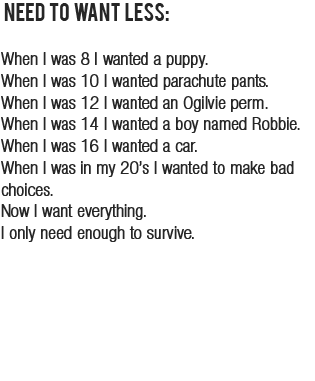
Need to Want: brilliant flashcards

One of my most consistently useful Twitter contacts is @brainpicker.  I'm often bookmarking links from those tweets.  The associated blog, Brain Pickings, is also worth delving through for gems, ideas, inspiration.  For example, this entry on Erin Hanson's Need to Want series.
I enjoyed Brain Pickings' analysis of these.

The ones I've chosen for here are the ones that most caught my attention as being of use for the study skills program I'm doing for Year 11 this term.

It's not what the kids will expect: always a good way to grab their attention and get them learning in spite of themselves.  I suspect this next one won't be the most popular with them, though.

Find the whole set here (source of these images), and the philosophy informing it:

And can buy prints of these from the artist at her online shop here.  (if you can't see the one you want, convo her (that's Etsyspeak for contact via Etsy email)).

Cheers
Ruth

Thursday, February 10, 2011

So what are they doing better in Finland (in education)?

Teaching less and learning more.  Read an excellent overview with handy graphs and a video in Less is More. Teach Less, Learn More by David Truss on Connected Principals.

“This creativity aspect is very important because in Finland we believe that risk-taking, creativity and innovation are very, very important for a society like ours. And particularly working in this global and globalized world it is more important than what you actually know and remember, it is more what you are and what you are capable of doing.” ~ Pasi Sahlberg


Worth reading the whole piece - click on over.  We seem, here, to be using the UK and US as our educational models, far more than places like Finland, even though the Finnish approach is more successful.
 
Cheers
 
Ruth

Thursday, February 3, 2011

Measuring your use of time

Toddling about the internet, collecting resources and ideas for the senior study skills program, I came across this article: "I shipped in 2010 - you can too" by Doug Johnson on his Blue Skunk blog.  While his main focus is on the extras he did related to his work, such as conference presentations, papers and articles, one sentence jumped out at me for its use with students.

I personally measure my days not whether they were happy or unhappy, but whether they were productive or unproductive.

One aspect of my work as a teacher is talking with students about their work.  They sit in my office and tell me their successes, failures, concerns.  Sometimes, tissues are involved. It's always been part of my work, not only through mentoring programs etc but also just because I'm findable, there, a listening ear. Thinking over what they say, often enough it is about happiness - "I feel terrible" "Nothing is working" etc - stuff related to feelings/emotions.

The rest of the paragraph reads like this:

Did I have a fruitful conversation or meeting? Did I get something finished? Did I write something worth sharing? Did I read something challenging? Did I do an hour's worth of physical activity? Did I clean up a mess, revise an article, or organize something for the future? Did I do something that made my own life or someone else's just a tad better?


Looking at this idea, it's one I plan to try with students, and see how it can be worked into the study skills program, too.  Refocusing from emotions (so much trickier to wrangle) to more measurable activities/achievements that can be done/replicated and from which positive feelings can flow seems like a useful idea to play with.  I'm not saying that feelings aren't important, but rather that this is a way to get from the tissues/tears/frustrations/sense of impotence/being stuck that some of those students have when they plonk themselves in a chair in my office, and help them onwards.  From a study skills program perspective, it also points a way from the emotional to the measurable, helping students to progress.

Cheers

Ruth

Friday, January 28, 2011

Effective study: ethnicity vs good habits

There is, wandering about in the education world, an assumption by some that the success of some ethnic groups is related to their ethnicity.  A recent SMH article, reporting on a  DET NSW forum, debunks this.  Chinese students top the tests out of habit, not ethnicity, study shows, by Anna Patty was published on 29 December 2010.  (nb: sometimes the SMH only leaves articles up free for a couple of weeks, and then you have to pay - try the link, but apologies if it doesn't work).

Key points:
  • The place where children do their homework - whether at a desk or in front of the television - may play a big role in how well they do at school
  • ''Successful students see homework as a daily routine,'' Mr Coutts-Trotter said. ''They have a desk of their own and a school and family that help them develop scholarly routines.
  • "Visiting libraries regularly is another thing successful students do.''
  • Children do better sitting at a desk than on a bed; implies a different attitude
  • From primary school, some groups establish better habits - study each day, and for longer.  In the year 3 group studied, the children of Chinese background spent about an hour every night of the week, compared with children of Pacific Islander background - 10 minutes for two to three nights a week - and Anglo Australian children - about 20 minutes on only some nights during the week.
  • Socio-economic background wasn't necessarily a factor in success/failure - good habits helped at any level
I'm interested in this because I'm working on a study skills program for Year 11 which will be running in term 1 this year.  This sort of information demonstrates that students can choose how successful they are; one theme running through the program will be the small choices that add up to greater achievement.  Time.  A desk.  Habits.

I've been bookmarking some resources for this program over in my Delicious Diigo; I'll likely highlight some here, but if you want to toddle over there for a squizz, you're very welcome (there is a preview of the most recent ones over on the right).  If you have ideas/bookmarks you'd like to share in return, please do leave a comment.

Cheers

Ruth


    Thursday, January 27, 2011

    How to learn? from mistakes (Diana Laufenberg)

    To start the new school year*, an inspirational TED talk about teaching


    Her three key points (and please do watch the video, don't just clock these and click on in your travels - it's a great ten minutes) are:
    • experiental learning
    • student voice
    • embracing failure
    Page URL if the video doesn't work for you:
    http://www.ted.com/talks/diana_laufenberg_3_ways_to_teach.html

    Cheers

    Ruth

    *Yes, the Australian school year follows the calendar - we've just finished our summer holidays and are back for a new school year.

    Tuesday, November 30, 2010

    Resources for Study Skills

    I'm working on a Year 11 study skills program for next year, and this page of links has an extensive list of sites - some more useful than others, but a lot that are useful.  Worth a squizz.

    Cheers

    Ruth

    Wednesday, September 1, 2010

    The happy life of teacher librarians: are you sure the brother died, sweetie?

    Helping a kid with a speech on Hana's suitcase.

    OK, you can focus your speech on an incident in the book that really had an impact on you. (teacher has told me kid x has read the book).

    Kid: Well, I guess the bit where she found out her brother was dead

    O-kay...but are you sure the brother died?

    Kid: Oh yes, George died.

    There's a picture of George as a man here in the book...

    Kid: He died, miss.

    And here's a paragraph about it (reads paragraph, which describes GEORGE finding out how HANA died in Auschwitz - George having survived the war).

    Kid: that's right, Hana died.

    Now about your speech, what else do you remember about the novel?

    Kid: Dunno

    But you read it in class, all together

    Kid: Yeah, but I didn't listen much.

    So why did Hana have to pack a suitcase?

    Kid: it was the war

    Which one?

    Kid: the one with the Nazis

    And that was - ?

    Kid: World War.

    World War 1 or World War 2?

    Kid.  One.  Two.  One.  No, it was Two, wasn't it?

    Right...

    by the end of the lesson, we had the beginnings of a speech....he went away with a printout of what we had composed so far, and we'll work on it a bit more when the class returns.  There are a couple of others especially needing one on one help, and whose removal from the class makes it all work just a bit better...

    The happy life of teacher librarians: one step at a time, and make sure you know WHO died (!)

    Cheers

    Ruth

    Tuesday, August 31, 2010

    Handy weekly planner for students

    While the PocketMod, as previously mentioned on this blog, is a handy-dandy, cute as a button one-week planner for students, the site's availability seems to vary.

    Plan B is this less cute, but just as effective planner from Victoria: http://www.vcehelp.com.au/resources/vcehelpstudyplanner.pdf

    So if you have a mentor group, or year group, or kids needing study/organisational help, this might be just what you're looking for.  More than a grid, but less (alas!) than the folding and cutting fun and cuteness factor of the PocketMod.  (Confession: I ended up making a version of the PocketMod using Publisher, just to share with my kids here.  But the VCE planner is a good one too).

    Cheers

    Ruth

    Thursday, June 17, 2010

    It's a busy life!

    Sorry for the hiatus in posts - so much else keeping me busy! 

    Had great fun yesterday working with Year 11 extension English students in a double period.  The teacher and I wanted them to think about how novels begin, so I put together a document with the beginnings of about twenty-two novels, from Ludlum to Atwood to Novik to Shan to a variety of teenlit authors.  The students could look at the book covers only (not blurbs, not open them) and had to work out which beginning went with which book, just using clues from the text and the covers.  They started off thinking it was an IMPOSSIBLE task.  Love setting impossible tasks and watching students find they're do-able...  I told them that if they got it out, I would shout them a hot chocolate (I'd stocked up with a pot of Choc-o-latte that morning).

    About six were guessed fast because one or other student had read them.  They had to think, and consult each other (it was an all or nothing competition, they had to collectively arrive at their choices).  Discussion went on about what covers were signifying, and what the words of various beginnings implied - chicklit, thriller, fantasy and so forth.  Students would say, I think this cover is for this beginning, and would then have to justify their choice and see if others agreed.  If they got it right, and all agreed, and had justified their answer, I took the book from the long table at which they were all sitting, so they could see what was left to match up.

    And they got it out.  And were not only very pleased with themselves for solving the 'impossible task', but pleased with the hot chocolate (I like random/intermittent rewards like this - but not the every-lesson lollipop, which seems unduly expensive and seems also to lead to whining kids).  We're part way through going around the group and asking them which three beginnings they like best - the next stage of this is looking in greater detail at writing techniques, comparing, contrasting, considering what they can find to add to and improve their own writing.  Interestingly enough, as we tally favourites, the Atwood (The Handmaid's Tale, one of my favourite book beginnings - everything is there in that first chapter about the gymnasium) is proving to be popular with the students, too.

    They're coming back in a fortnight for their next double.  More fun to be had!

    I've been working with some Year 7 English classes on a biography assignment too (which is called, "Who are they and why should we care?") in which they have to think of ways to present their information in an interesting way - eg. in a model.  They've been enjoying that.  At the end, they get 10 votes each to give to other students in their class - only one vote per colleague - and this is taken into account as part of the marking.  A certain amount of friend-voting goes on, but the outstanding ones draw votes from friends and colleagues.

    With Year 11 Visual Design, on a longer term assessment task on picture books, we're at the beginnings - illustration techniques, writing techniques and so forth - they have to produce their own picture book.  The Vis Arts teacher and I selected a bunch of picture books to show them - it was fascinating to see our overlapping but not identical focus, me a tad more on words, she a tad more on images/techniques/artwork.

    And so it goes, and so it goes.  That's just some of the iceberg keeping my workdays happy and occupied.  I'm sure yours are the same!

    Cheers

    Ruth

    Friday, February 12, 2010

    USBstick/flash drive bracelet & hub (but cute)

    A flash drive/nerd necklace/USB storage stick, call it what you will, has become pretty much essential to everyday work, hasn't it?  If you're not the nerd necklace sort, or all your work outfits don't boast pockets, or you don't carry about one of those HUGE teacher lanyard+keys+flash drive bundles, another option is a silicon bracelet USB stick/flash drive.  Smiggle has them, in bright colours or sober black (on which you could use a black texta to make the brand name disappear, if you wish).

    You can buy them online here or at Smiggle shops.  They are only 2GB for $24.95; but that's enough for daily working, and the convenience factor is part of what you're buying - I know some of my flash drives have had tiny lids, very easy to lose .  An idea for kids, too (and don't forget to remind them that the only copy of their brilliant work shouldn't be on a flash drive and nowhere else - they are transit devices, not permanent storage).

    The other Smiggle electronic item which combines cute with useful is their hub.  Most USB hubs are drably functional.  How about a turtle hub?

     
    $19.95.  Buy them online here, or also at a Smiggle shop.

    Cheers

    Ruth

    PS. This is not a paid editorial. 

    PPS. You can blame the gadget gene that runs in my family.

    PPPS. Also that I am bored with trying not to lose tiny flash drive lids from cheap flash drives.  I know, I should get the ones with attached/swivelling lids.

    Monday, February 8, 2010

    Bargain planners (for my mentee kids)

    One of my Visible Teacher Librarian roles in the school is to mentor senior students.  At my school, all senior students, and all teaching staff, are offered the opportunity to participate in this program.  How you work with your student/s is up to you (most people take on one or two students).  Since I elected to take three Year 11 students last year, and was requested by four, I took the four, but decided I needed to be more systematic in working with them - especially, to see them all together for regular meetings, so this extra involves one period per cycle, not four.  I also thought the synergy of the group, sharing their own ups and downs, would benefit them.

    The topics we've covered have been partly decided by me (based on what's going on in the general school timetable, eg. exams) and partly from student suggestions - how do I do this? get organised? work out a study plan? etc.  I've also shared my worksheets on the school intranet so other staff can use them with their mentees if they wish

    Planning and organisation have been consistent themes.  My first meeting with my now Year 12 group (I've farewelled my last year's HSC mentees and have not yet acquired this year's Year 11's, although I've had two students approach me so far...) is today.  I was so pleased, yesterday, to happen on this bargain at Smiggle (a shop full of funky mad stationery - they have physical shops and a website).


    A year planner is a great tool for students to have in their room at home, and this one from Smiggle, reasonable at its original price of $4.95, but better still at its current bargain price of $2.50, is just the ticket.  I bought some (of course!).  You can (fingers crossed) find them at your local Smiggle shop (they were available online here but have sold out).  Might also be handy if you want a library year planner (I use the teachers' credit union freebie in my office, as it has NSW government school terms/hols etc).  If you miss out this year, worth remembering for next year.

    I was going to fossick about online for a year planner for them, but that would have to be printed on A4 and put together, so this (which has some colour) is excellent.  We will be sitting down with various coloured highlighters and pencils and the assessment schedule, so each student will make this planner their own.  Then they'll have to take a photo of it on a wall at their home, just to show me that it's doing its Visible job...

    Cheers

    Ruth

    Tuesday, September 1, 2009

    Set texts vs student choice

    In a New York Times article on the future of reading, Motoko Rich  describes US programs where instead of a set text, students choose their own reading matter.  Very interesting - do read Students Get New Assignment: Pick Books You Like.  Room for library involvement in this 'reading workshop' approach...
    .
    I also noted with interest that comfort - something we've been working on this year in the library with, for example, the reading retreat and the floor cushions - is part of the approach, thirty minutes of reading each day in a beanbag or comfortable situation (not just at a school desk).

    Author Meg Cabot commented on the NY Times story - read it here.
    .
    Cheers
    .
    Ruth
    .